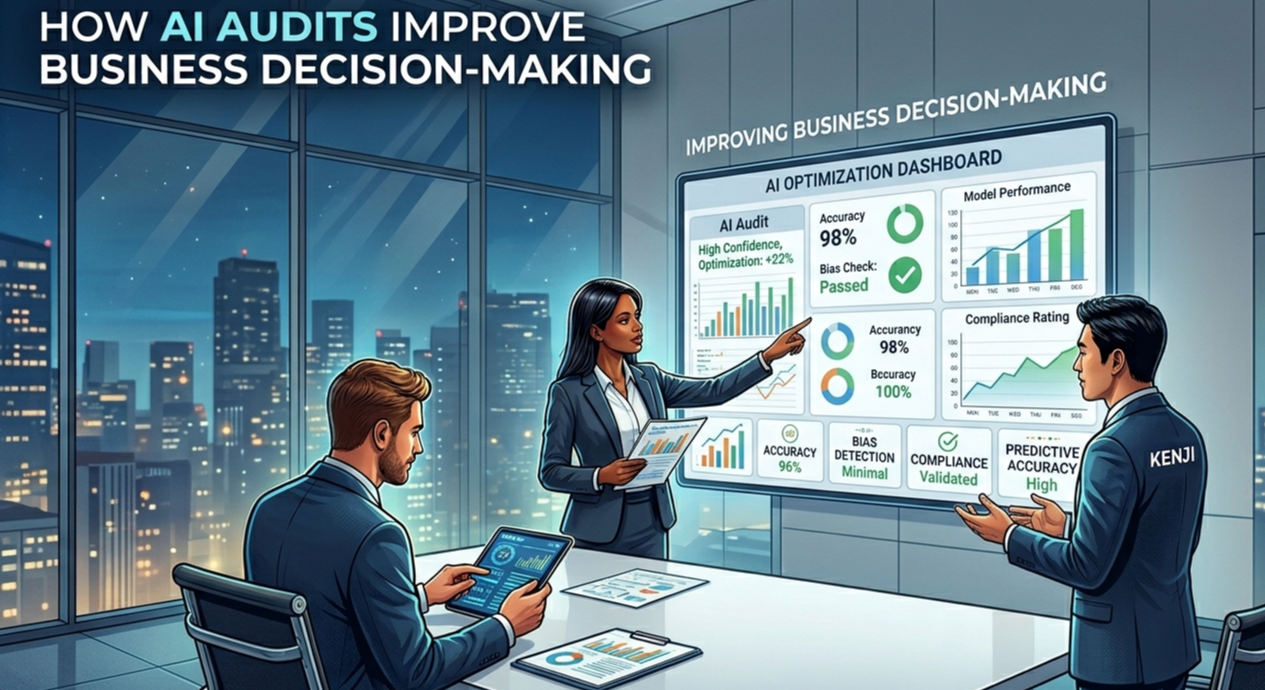
- AI audits help companies see if their AI tools are doing the job—accurate, secure, and also actually useful results, not just something that looks convincing
- In practice they show weak data, skewed outputs, security gaps ,and sometimes model logic that feels unclear before any of it messes with business decisions or the timing of approvals
- From there the audit results guide leaders in choosing what to refine, grow, halt, or swap out, rather than hoping everything is fine
- When audits are done on a regular basis, businesses can treat AI like a managed asset, rather than a high stakes experiment that might spiral later
AI has moved , kind of steadily, from those pilot projects into daily business operations. Like now companies use AI for forecasting, customer support, fraud detection, document processing, marketing, hiring, pricing, and internal analytics too. These systems can speed up decisions but they also bring serious risks if nobody really checks how it works, or how it is being used.
A model might rely on outdated data. A chatbot can end up sharing the wrong information, in a very confident way. A recommendation engine may nudge customers toward poor offers, instead of the good ones. And a forecasting tool can mislead managers right before a major budget decision , when it really matters.
Read: What is Cloud Adoption? 10 Key Advantages of Taking on Distributed Computing for Organizations
Why AI audits matter for business leaders
AI audits give leaders kind of a straight look at what goes on inside their AI systems. If there’s no audit, business teams might depend on what the model spits out , without really knowing if the data is clean, if the system follows the business rules, or if it handles those weird edge cases in a reliable way.
An AI audit looks at the whole AI setup, not only the algorithm ,like people sometimes assume. It can assess data quality, model performance, security, compliance, who can access it, integrations, ongoing monitoring, and how well everything lines up with real business goals.
This becomes kinda important, because AI tools often sway high stakes choices, yeah. A retail company might use AI to predict demand, and maybe even to do it faster. A bank may lean on AI to catch fraud early, but sometimes it’s subtle. A healthcare company could use AI to sort triage patient requests, in a more or less rapid way. And a startup may use AI to score incoming leads or, you know quietly, to automate support in the background.
And when these systems perform smoothly, they can save a lot of time. But when they stumble, they might hurt revenue, erode customer confidence, and damage the company’s reputation.
How AI audits turn uncertainty into evidence
Companies implement AI simply because their competitors implement it without any performance rationale. Audit will allow to substitute assumptions with facts.
Audit will answer such specific questions:
- Is there a business issue that the AI solution solves?
- Does it contribute to faster, more accurate, cheaper or better service delivery?
- How is performance by the model across various user segments?
- Is the system based on accurate data?
- Are the outcomes understandable for employees?
- Is there an understanding of ownership of the AI solution?
- Does the system comply with all requirements regarding security and privacy?
These answers allow to manage budgets, headcounts, products, and risks better.
AI audits help companies choose which projects deserve investment
A bunch of businesses now sorta test several AI tools all at once. Sales might use AI for lead scoring , while marketing uses AI for content ideas. Finance can lean on AI for forecasting. Customer support may roll out AI chatbots, and that’s it.
The issue is kind of straightforward: not every AI effort really deserves more funding right now.
An AI audit kinda helps, compare each AI initiative based on business value and risk. It can reveal which tool actually saves time, which one tends to create mistakes, and which one just needs better data before it can scale up in a real way.
For instance, a company could find that its AI customer support bot handles easy requests quite well but then struggles when people ask about billing , refunds , or account access. Rather than expanding the chatbot too early, leaders can tighten up the knowledge base, set human handoff rules, and lower the overall customer frustration.
In the end, the audit makes the choice clearer. Expand what works, mend what still has potential, stop what simply wastes time.
AI audits reduce poor decisions caused by weak data
Artificial intelligence requires data; however, when the data is partial, duplicated, out-of-date, or biased, the output of AI systems is substandard.
Poor quality of data could have bad business effects, such as overestimating customer demand using sales forecasts, ignoring changes in the marketplace while using price models, screening off high-quality applicants using the hiring process, and incorrectly detecting unsafe users with the fraud system.
AI audit examines the ways data is entered into the system, data sources used for analysis, how data is cleaned up by teams, frequency of updates, and user access permissions.
An effective AI audit would expose issues like:
- Absence of data sources
- Old data
- Duplicates
- Faulty data labeling
- Inconsistency in data format
- Unnoticed data bias
- Insufficient access control
Quality data brings quality AI decisions.
AI audits expose security and privacy risks
Most AI applications have access to databases, internal networks, cloud storage, APIs, and third-party platforms. Each one of these presents a security hazard.
Employees might also employ publicly available AI tools without official authorization from the employer. In doing so, employees may copy client details, financial information, company documents, or source code in applications that the firm doesn’t regulate.
The AI audit identifies such security gaps before causing any harm to the firm.
Some security reviews include:
- Access controls
- API security
- Data protection
- Data retention
- User controls
- Third party tools
- Cloud configurations
- Audit logging
- Information leaks
For firms operating in finance, healthcare, insurance, retail, or law, an audit is even more critical since they handle sensitive data. Besides, compliance pressure is also higher in these industries.
Punchline: Often, AI risks lurk in the workflow, not just the model.
AI audits improve compliance and accountability
As AI becomes part of the processes of any business, there is a need for accountability and ownership of the process. One person should be able to tell who authorized the use of the system, who monitors its performance, who handles incidents, and when it should undergo modification.
An audit will play an important role in establishing accountability by laying down the processes that the AI goes through and the procedures involved therein.
Such information could come handy for many processes including internal governance, customer due diligence, and even future audits.
The key elements of an audit of an AI system are:
- Ownership of the AI system
- Authorization of changes
- Monitoring of performance
- Incident reporting
- Handling sensitive information
- Review of the model
- Risks that require immediate response
For management, such information will go a long way in ensuring control. For engineers, it sets guidelines and boundaries. For legal and compliance departments, it provides evidence.
AI audits help leaders understand real ROI
AI solutions usually push speed and efficiencies, yet executives want proof, you know.
The audit can judge the costs tied to the AI solution against its real advantages , kinda like a balance sheet but more pragmatic. That review typically covers development expenses, subscriptions, cloud services , ongoing upkeep, human reviews and the adjustments that come after corrections, plus training sessions.
After that, the firm will be able to compare costs against tangible benefits, including:
- Time savings
- Less work required by humans
- Faster response rates
- Increased conversions
- Less support
- Improved forecasts
- Lower risk of loss due to fraud
- Increased customer retention
This allows executives to avoid committing two common errors: scaling AI without generating value and stopping AI when data improvements are needed.
When should companies run an AI audit?
AI audits should be conducted prior to AI implementation, after any material upgrades, and when performance begins to degrade.
In addition, an audit might be advisable if:
- the firm intends to roll out an AI pilot
- AI touches customers or employees
- the teams have access to sensitive data
- there is a vendor supplying the AI system
- unauthorized AI software usage by employees exists
- managers do not understand AI output
- the company launches in a regulated sector
- inconsistency becomes evident from AI output
AI systems can evolve over time due to alterations in data, user behavior, and policies. The model that used to work half a year ago may now underperform.
Continuous auditing will help you notice such changes earlier.
What a useful AI audit report should include
An effective audit report must avoid confusing business leaders with technical jargon. The report must relate findings in technical terms to their business implication.
These must be contained in the audit report:
- Critical risk exposures
- Impact on business operations
- Findings from model performance assessment
- Quality of data
- Shortcomings in security measures
- Compliance problems
- Simple solutions
- Major recommendations
- Priority rating
- Action plan
Effective audit reports are those that prompt leaders into taking action.
Final thoughts
AI audits help business decision-making a lot, like they give companies real facts, not just guesses or gut feelings. in other words leaders can get a clearer view of whether AI systems are correct, resilient, compliant, explainable and also actually helpful in practice.
When a company does an audit of AI, it can move forward with more confidence. they can expand the strong projects, mend the weaker ones, cut down on security exposure, and keep customers safe from automated choices that are poor or just off in the real world. AI is going to keep sliding into even more business processes, so the companies that check how their AI performs sooner rather than later, usually make better decisions, waste less money, and build stronger trust with users, employees, and partners too. And for teams who need an external look at AI models, data flows, security, and business value, professional ai auditing services can help turn those AI risks into practical, clear improvement steps that people can follow.
About the Author