For startups in their infant stage, how quickly you can get a product off the ground is critical. The founder has to quickly validate their assumptions and find out if their product can actually help solve a problem for users of a product and who want to use it.
A lot of people think that just because users will interact with the interface of a product, they should focus on that interface first. A well-designed interface that is easy to navigate, has good user experience, etc are certainly important, but they aren’t always the most important foundation for a new product.
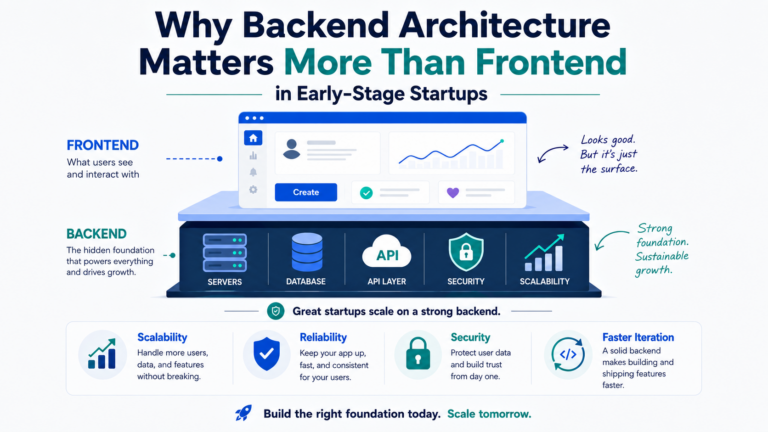
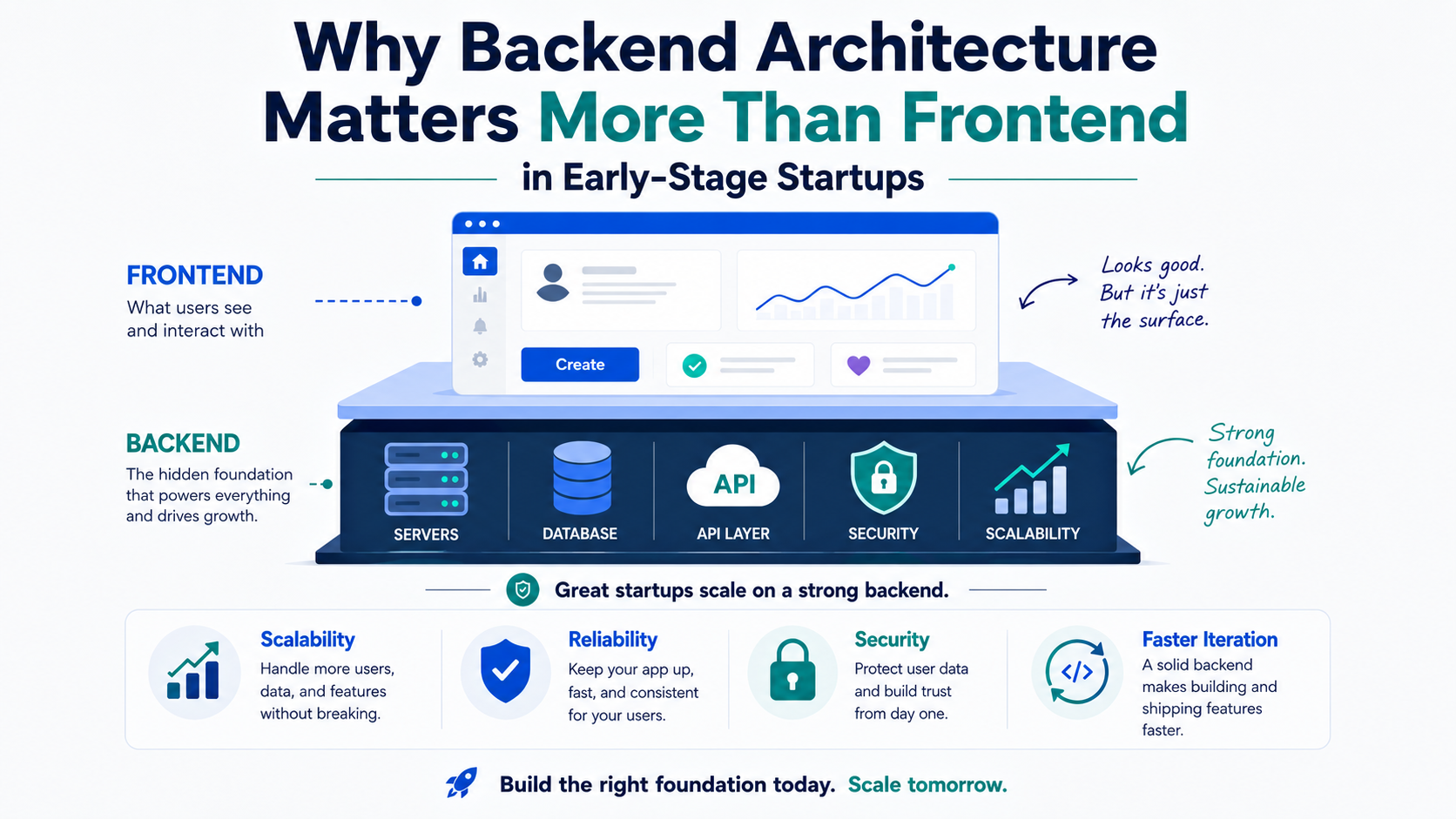
For a startup in its infancy, backend architecture is generally more important than front-end polish because backend architecture is what determines whether or not a product can scale, is adaptable, can integrate and will work as designed in the hands of end users.
The Backend Is the Product’s Foundation
The backend serves as the basic foundation on which the entire product rests. It represents the technological side of a program (the logic), whereas the frontend represents how this technology will be displayed to end users (the visual side). All critical product functions rely on logic from the backend to operate properly – including user authentication, data storage & processing; payment solutions; demonstration systems; notification systems; analytic systems; integration with third parties; permissions; searching; automation; business rules; etc.
Although the range of capabilities offered by a startup in its initial offering can change rapidly by changing the user interface, once a startup has established a poorly designed back-end codebase, redesigning or redeveloping this codebase can be an extremely cost-prohibitive, risky, and time-consuming undertaking.
At the stage of developing their Minimum Viable Product (MVP), startups frequently underestimate the importance of a strong backend and site that “just provides support” for the user interface. However, this perspective completely ignores the fact that the long-term flexibility of a product is determined by the backend. It determines how data will flow through the system, how features will connect to each other; and how much effort/expense will be needed for the product to successfully evolve after it is launched.
Read: The Ultimate Guide to Integrating Generative AI into Full Stack Apps
Frontend Can Be Replaced Faster Than Backend
Frontend technologies are always rapidly changing. User interface trends, specifically, are even more rapidly changing than frontend technologies. A landing page, dashboard, onboarding flow, or mobile screen can be redesigned without having to completely change everything about the way that the product works.
Backend decisions, however, can be difficult to reverse. Database structure, API design, authentication model, infrastructure choice, and integration logic are all things that can get entrenched in the product and create long-term technical issues. Poor planning or rushed decisions on these areas can lead to every future feature being more complicated to develop than it should have been. What might have been perceived as a shortcut in the moment, can ultimately become long-term technological debt that in turn causes all of the company’s development to slow down.
For an early-stage startup, this is important because it is highly likely that the product will change over time. The first version of the product is generally not going to be the last version of the product. Founders will typically be required to pivot their company, add new customer segments, have multiple pricing tiers, support an enterprise client base, and integrate with third-party integrations. A backend that is flexible enough to accommodate these changes will make it much easier to implement them. A backend that is not flexible enough to accommodate these changes will create severe pains every time a change is made.
Scalability Starts Before Growth Happens
Many startups think that they can deal with scalability, once they gain traction. This is a big mistake.
An enterprise-level infrastructure is not required for early-stage products right out of the gate, but it is critical to have an architecture able to support a sharp increase in use, if the startup receives media coverage, lands a new significant customer, or runs a successful marketing campaign.
Inadequate back-end architecture puts a startup at risk for slow response time, lost transactions, inconsistent data, security vulnerabilities, and outages. These issues become critical for a startup where there is still trust to be established by the customer. While they may tolerate an imperfect front end or interface error, they will not tolerate a loss of data, a broken payment, or repeated down time.
A solid back-end architecture gives startups the opportunity to prepare for growth without over-engineering the solution. It allows the team to design a system that is simple enough for the current needs, yet durable enough for the future growth needs.
Support a Faster Iteration through Backend Architecture
Startups must be able to work quickly; however, the speed of development is not achieved by writing code once quickly. Rather, it is achieved by quickly modifying the product over and over without damaging it.
The backend will help speed up the development cycle by providing its developers with an easy way to iterate on their product through clean APIs, modularized services, well structured data models, and consistent deployment processes. All of these tools will enable developers to add functionality to their product, validate new ideas, and identify bugs more easily than when the backend is not well structured, so they can iterate on the product faster. This is really important for new startups who may still be discovering what customers really want.
A poorly architected backend system introduces risks with every new functionality that is added. Developers spend too much time trying to untangle previous decisions, instead of being able to add new functionality. As a result, product trials can take longer to complete than they should, bugs take longer to fix, product demos are very stressful for the team, and there is always an abundance of requests from customers that cannot be fulfilled efficiently because of the limitations of the system.
In this way, the backend architecture does not just impact technical development; it has a significant impact on business agility.
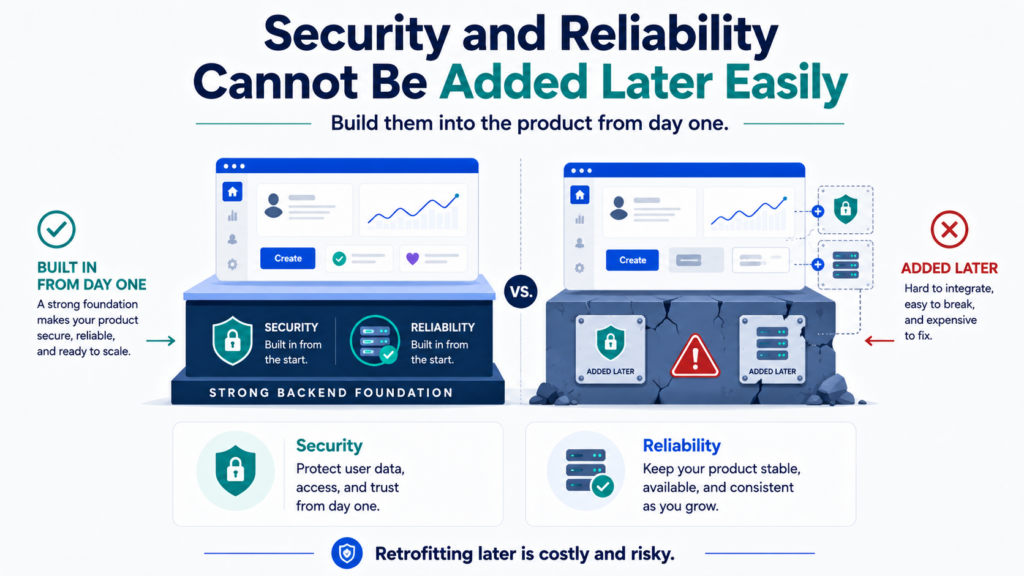
Security and Reliability Cannot Be Added Later Easily
As a startup, you may think that your team hasn’t needed to incorporate security into their work yet due to the size of the product being developed. The reality is even small products can contain sensitive information such as customer emails & passwords, payment information, or other intelligence about the customer.
The protection of that data is primarily based on the way a startup architected their system. Thus, systems will be able to create a process for protecting the data they collect through their product by using authentication methods, authorization protocols, encryption mechanisms, controls to restrict access from hackers, logging user activity, backup plans to recover lost data, and secure API design.
All of these security processes should be part of the initial system architecture; but if you decide not to create a secure architecture initially, then adding security to your existing product later may introduce significant complexity and cost as we’ll discuss in detail later in this article.
Reliability is similar. Monitoring, error handling, database backup and restoration processes do not generally seem urgent during MVP development; however, when actual users are dependent upon a product being reliable, they become an extremely important part of the overall process. A product with a strong frontend will still not be able to overcome issues if the backend does not consistently provide functionality or if the backend does not include proper error-handling or work appropriately with the database (e.g., those types of systems may constantly lose data or provide unreliable results).
Integrations Depend on Backend Strength
Most of today’s start-ups offer products that connect to other products as they provide their service to customers. Therefore, most of these integrations take place through the back-end.
If the back-end is poorly built, many of the integrations can be very fragile, tough to manage and to keep working. For example, the API integration can be inconsistent and the data may not sync, which leads to a problem because there are multiple third parties and products involved.
Therefore, B2B companies have the opportunity to use integration as a sales tool. Customers look for products that will fit within their current workflow.
A well-built back-end allows start-ups to have the flexibility to integrate with the tools that customers are already using which ultimately leads to better product acceptance and increased customer retention.
Good Backend Architecture Helps to Keep Costs Down
Startups in their infancy need to utilize their limited budget very wisely. It can appear attractive to develop a minimal backend in haste as it will appear less expensive initially, however, through poor design, it is likely that costs will be incurred in later stages of development.
Once your company becomes larger, inefficient database queries, excessive server load, lack of caching, inadequate infrastructure planning as well as the requirement for labour to maintain your operation will all increase your costs.
In addition to cost, a poorly designed backend will result in a complete redesign at the time when your company is attempting to grow, sell or obtain financing.
Good backend architecture does not necessarily mean creating a complicated system early; it means making the correct decisions up front to minimise waste in the future. The goal of developing your system should never be “over engineering”; the goal should always be to prevent any decision that will hinder growth.
Final Thoughts
While early-stage startups focus on their frontend, the backend is what creates and delivers a product and allows it to grow over time. A polished user interface can help provide a positive first impression to users; however, how the backend is structured also determines how the product can grow in terms of scalability, reliability, security, integration, development speed and long-term cost — all of which are fundamental aspects of turning an MVP into a viable product.
Startups should pay attention to the quality of their frontend, but they should also consider that the best possible technical investment during the earliest stage of startup development is often something that users will never see: backend development solutions that are flexible, secure, scalable, and adaptable to change. Therefore, when startups experience growth, the primary concern will not be whether the product appears attractive; it will be whether the product can support its success.
About the Author