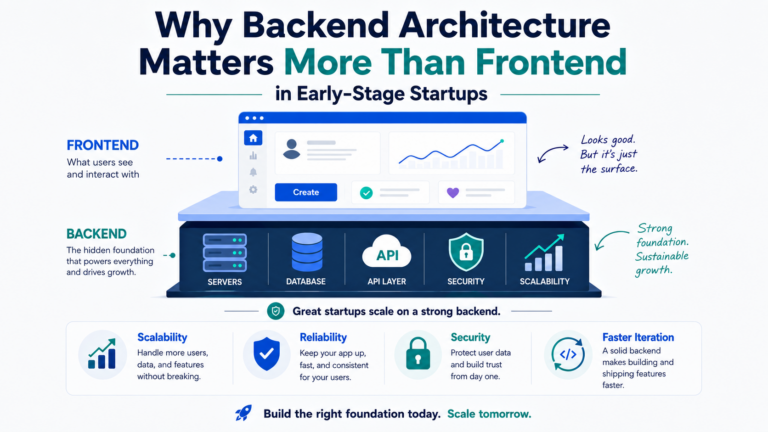

The “AI as a Gimmick” Era Is Over! Software today has transitioned from using a static user interface to using intelligent systems that can reason, summarize, and run complex workflows. Many businesses still depend on traditional Full Stack Development Services to support their legacy systems, but a business’s differentiator will be its ability to directly embed Generative AI at the Application Layer of the software.
Moving a Generative AI functionality from a local script to a full-stack production environment introduces many unique architectural challenges and necessitates a shift in how we think about and handle our application state, data, and user experience. This guide provides a breakdown of the Modern AI Stack and walks you through implementing the RAG Architecture, so you can map out the process for creating AI features that are fast, secure, and inexpensive.
1. Building the Modern AI Stack: Beyond the API Call
When developing an AI-powered application there is much more you will need than a simple API call. In order to gain the full potential of AI in your product, you should be aware of the following three layers that comprise the modern AI stack:
- Intelligence Layer: This represents the reasoning engine within your application and will require you to choose between commercial (i.e., proprietary) AI models, such as GPT-4o from OpenAI or Claude 3.5 from Anthropic, or high-performance open-source alternatives (e.g., Llama 3 hosted on Groq).
- Orchestration Layer: This serves as the “glue” for all aspects of your AI-powered application, managing the flow of logic between the end-user of the application, your database and the AI model. Most developers will use frameworks such as Vercel’s AI SDK or LangChain to orchestrate this flow of logic.
- Context Layer: As LLMs do not update in real-time, there must be a way to pass them information about new events that might impact their responses after they are trained. Vector databases (e.g., Pinecone or prod pgvector from Supabase) are necessary to accomplish this.
According to Gartner’s prediction, by 2026, 80% of enterprise software will have incorporated some level of access to generative AI. This means that developers need to possess the skills necessary to build applications that utilize all three layers in the modern AI stack.
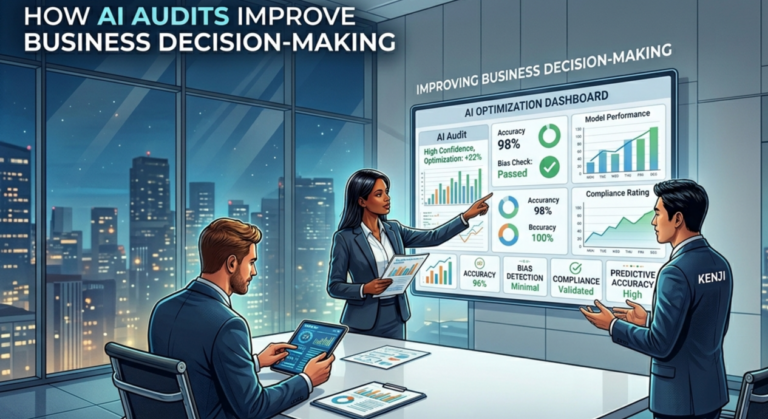
Read: How AI Audits Improve Business Decision-Making
2. Architecture: Solving the Client-Side vs. Server-Side Dilemma
Your LLM API integration architecture will be shaped by your organization’s primary objectives (security and performance) in relation to LLM APIs. It is easy to call an AI API from the frontend of your application, but this exposes your API keys to users and can lead to abuse of your application by allowing for direct access to your API without additional security measures.
Why Server-Side AI is Mandatory
One of the most important things to remember when designing your architecture is that all logic should be performed on the server-side. This will allow you to properly sanitize user input and manage the current number of requests from a single user. Additionally, it will provide a secure location to store sensitive keys.
Leveraging Edge Functions for Real-Time Streaming
Many AI applications suffer from latency in response times. To reduce response times and improve a user’s experience with your AI application, consider utilizing Edge Functions (e.g., Vercel or AWS Lambda@Edge). This will allow you to stream AI responses via Server-Sent Events (SSE). By streaming responses in this manner, users will see the same visual feedback as they do when a typewriter types out a message. This is accomplished by presenting the user with visual evidence of the completion of the model.
3. RAG Architecture: Eliminating AI Hallucinations
Incorporating Generative AI into a complete stack applications has the largest challenge of “hallucinatory” experiences. If the AI does not ascertain an answer with its own internal brain, it will generate answers that are not true but may presume to be correct. By using Retrieval-Augmented Generation (RAG), you can ground this model into your existing dataset.
The RAG Workflow:
- Chunking/Embedding– Breaking down the input (in the form of PDFs, documents or DB records) into small paragraphs/chunks of text which can then be placed into numerical format known as “vectors”.
- Vector Storage – All vectorised input will be stored in a Vector Database (examples include Pinecone, Weaviate) using databases’ native protocols.
- Semantic Retrieval – Following user query input, an application queries the Vector Databases and retrieves the most semantically meaningful/closest data chunks to the user’s question, passing them on to the AI to provide “Context” for the AI-generated response.
With RAG, the AI no longer has to “guess” at what information to provide and can now cite users back to the specific sources of data, creating greater levels of trust in its recommendations by users.
4. Comparing Frameworks: Vercel AI SDK vs. LangChain
Selecting the appropriate framework is contingent on your technological stack and the intricacy of the features required.
- Vercel AI SDK (Best for React/Next.js): The Vercel AI SDK is best suited for frontend-heavy developers and is the preferred option for React/Next.js development. It offers the use of specialized hooks such as useChat and useCompletion, which handle streaming and UI state automatically.
- LangChain (Best for Complex Workflows): If your application requires “Agentic” workflows, i.e., where an AI interacts with calendars, sends emails, or queries SQL databases, LangChain is the preferred framework. It is designed to facilitate multi-part reasoning capabilities as well as sophisticated data component pipelines.
5. UI/UX Patterns: Making AI Feel Instant
To design an effective AI system you need to consider how to handle non-deterministic output. Since you cannot predict what an AI will produce each time, your UI must account for this variability by being resilient to the many different outputs you can get from an AI.
- Optimistic UI & Skeletons: Optimize your design using Loading Skeletons which act as loading indicators and inform users where to find their content when it’s available thereby reducing perceived waiting time.
- Human-in-the-Loop Design: Include a Human-in-the-loop design which provides users with the ability to edit and verify AI generated content. A thumbs up/down or edit button gives the user a mechanism for providing feedback for future fine-tuning.
- Smart Caching: Implement Smart Caching through Redis to cache the most frequently requested query responses by storing query contents, so that if multiple users request the same summary the cached response can be served immediately, thus saving time and cost in implementing AI systems.
6. Production Concerns: Scaling and Security
A significant amount of resources are needed for Scaling AI Applications as opposed to scaling a website. Every token that is produced costs money. There are a couple of ways to manage cost.
- Manage Costs— establish token limits to prevent unexpected charges. For basic tasks (e.g., classification) use smaller and quicker models like GPT-4o-mini; and use more complex models for more complicated reasoning.
- Defend against Prompt Injection— treat the output of LLMs like any other type of user input and properly sanitize it before rendering it as HTML, to avoid the possibility of xss attacks.
- Data Privacy— Keep PII (Personal Identifying Information) out of prompts before sending to Third Party APIs to continue your compliance with GDPR or SOC2.
7. Redefining the Future of Productivity via Agentic Workflows
Function calling will be the next step in Full-Stack AI. With function calling, the AI can perform actions rather than only responding with text. You will define your back-end functions as “tools,” allowing the AI to select a tool based on the intent of the user’s communication which could either be to check inventory or create a support ticket. Function calling will turn your application into an active agent as opposed to a simple interface.
Conclusion
You can maximise the value your users get from your full-stack applications immediately if you integrate generative AI into your apps. Start by creating a RAG architecture that is as clean as possible and ensure that you are using streaming to create the best possible user experience, as well as monitoring your token usage. When done correctly, your users will experience app-like magic when using your application, while at the same time, you will keep your enterprise infrastructure running smoothly.
Author’s Bio:
Akshay Tyagi is a content writer at NetClubbed, a premier full stack development agency. He is good at making sense of the constantly changing world of SEO and web development. He loves getting rid of technical language and replacing it with clear, uncomplicated plans that help organizations develop.
About the Author